


 English
 عربى
عربى


NEWS
Home / News / Industry News / Ultrasonic Welding Machine: The Complete Guide to How It Works, Types & Applications
Ultrasonic Welding Machine: The Complete Guide to How It Works, Types & Applications
Content
- 1 How an Ultrasonic Welding Machine Works
- 2 Types of Ultrasonic Welding Machines
- 3 Key Applications of Ultrasonic Welding Machines
- 4 Ultrasonic Welding vs. Other Joining Methods
- 5 Key Specifications to Evaluate When Choosing a Machine
- 6 How to Choose the Right Ultrasonic Welding Machine
- 7 Maintenance and Common Troubleshooting
- 8 Cost Considerations for Ultrasonic Welding Machines
- 9 Final Takeaways
In short: an ultrasonic welding machine joins materials by converting high-frequency electrical energy (typically 20–40 kHz) into mechanical vibration, which generates localized frictional heat to fuse thermoplastics or metals without adhesives, solvents, or external heat sources. The process is fast — most welds complete in under one second — and is widely used in automotive wiring harnesses, medical device assembly, packaging, and electronics manufacturing. Machine selection depends primarily on frequency, power rating, and whether the application involves plastic or metal welding, since these factors determine weld strength, cycle time, and suitability for a given material and part geometry.
How an Ultrasonic Welding Machine Works
Ultrasonic welding is a solid-state joining process, meaning the base materials do not fully melt as they would in conventional welding. Instead, vibrational energy is applied under pressure to generate friction at the interface of two parts, raising the temperature enough to soften or melt a thin layer at the joint. This makes the process fast, energy-efficient, and free of consumables like solder, adhesive, or flux.
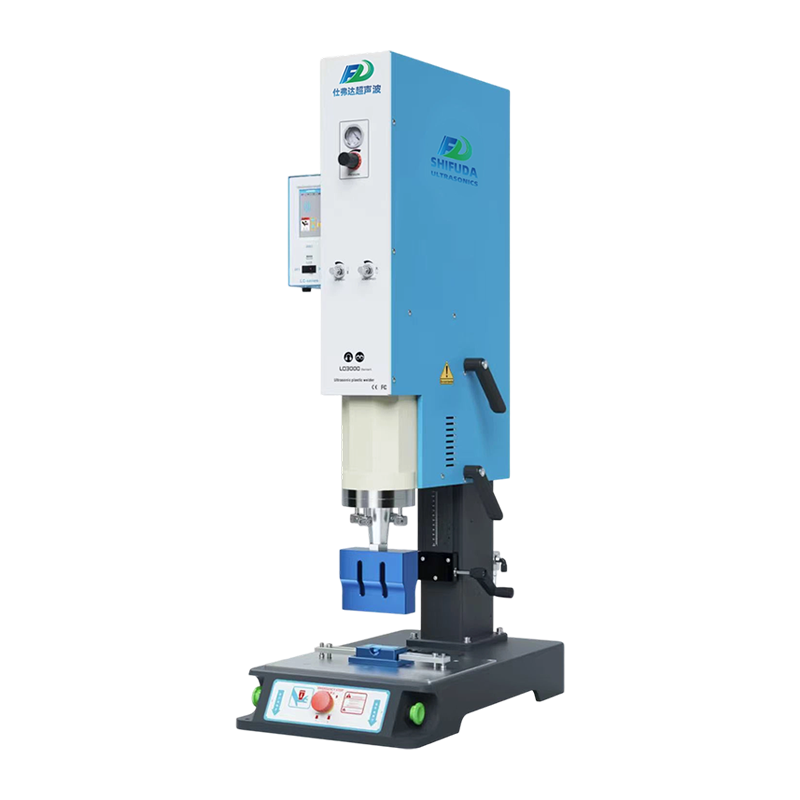
The Core Components
- Generator (power supply) — converts standard 50/60 Hz mains electricity into high-frequency electrical energy, usually 20 kHz, 30 kHz, or 40 kHz.
- Converter (transducer) — uses piezoelectric ceramic discs to convert the electrical signal into mechanical vibration at the same frequency.
- Booster — amplifies or reduces the amplitude of vibration passed from the converter to the horn, and also serves as a mounting point for the stack.
- Horn (sonotrode) — the tool that directly contacts the workpiece, transmitting vibration and pressure to the weld joint.
- Anvil/fixture — holds the parts in place and provides a reaction surface against the horn's pressure.
- Pneumatic or electric actuator — controls the downward force applied by the horn during the weld cycle.
The Welding Cycle, Step by Step
- Part placement: The two components are positioned in the fixture, typically with an energy director — a small raised ridge molded into one plastic part to concentrate heat at the joint.
- Pressure application: The horn descends and applies a preset clamping force, typically ranging from tens of newtons to several kilonewtons depending on part size.
- Vibration and heating: The horn vibrates at the set frequency for a fraction of a second to a few seconds, generating friction that melts the interface.
- Hold time: Vibration stops, but pressure is maintained briefly to allow the molten material to solidify and form a strong bond.
- Horn retraction: The horn lifts, and the finished weld is released from the fixture.
A typical plastic ultrasonic weld cycle completes in 0.1 to 1.5 seconds, making the process significantly faster than adhesive bonding or solvent welding, which can require minutes to hours of cure time.
Types of Ultrasonic Welding Machines
Ultrasonic welding machines are generally categorized by the material they weld (plastic or metal), their frequency, and their form factor (bench-mounted, industrial, or handheld). Choosing the correct category is the first decision point before evaluating specific models.
By Material Application
| Type | Typical Materials | Common Frequency | Typical Use Case |
|---|---|---|---|
| Plastic Welding Machine | ABS, PP, PC, PET, nylon | 15–40 kHz | Enclosures, packaging, filters, toys |
| Metal Welding Machine | Copper, aluminum, nickel foils/wires | 20–40 kHz | EV battery tabs, wire harnesses, busbars |
By Frequency
Frequency choice affects both amplitude and precision. Lower frequencies (15–20 kHz) produce higher amplitude, making them suitable for larger, thicker, or more rigid parts, while higher frequencies (30–40 kHz) produce lower amplitude and are better suited to small, delicate components such as micro-electronics and thin films, where excessive vibration could cause damage.
By Form Factor
- Benchtop/manual machines — operator-loaded, used for low-to-medium volume production or prototyping.
- Automatic/inline machines — integrated into conveyor or robotic systems for high-volume, continuous production lines.
- Handheld welders — portable units used for spot repairs, textile sealing, or on-site assembly where part size or location prevents fixed tooling.
- Rotary/continuous seam welders — use a rotating horn (roller) instead of a stationary one, ideal for continuous seams in nonwoven fabrics, films, and bags.
Key Applications of Ultrasonic Welding Machines
Ultrasonic welding is used across a wide range of industries because it is fast, clean, and does not require consumables. Below are the sectors where the technology has the strongest adoption.
Automotive Manufacturing
Automotive wiring harnesses rely heavily on ultrasonic metal welding to join multiple copper or aluminum wire strands into a single splice point, a process that can weld bundles of over 20 wires in under one second with consistent electrical conductivity. The technology is also standard for welding dashboard components, air filter housings, and battery tabs in electric vehicles, where clean, low-resistance metal joints are critical for battery pack performance.
Medical Device Assembly
Because ultrasonic welding produces no fumes, adhesives, or particulate contamination, it is widely used for assembling IV filters, syringe components, surgical masks, and blister packaging in cleanroom environments. The absence of solvents also avoids the material compatibility issues that adhesive bonding can introduce with certain medical-grade plastics.
Packaging Industry
Ultrasonic sealing is used extensively for blister packs, sachets, and nonwoven bags, particularly where the product inside is heat-sensitive, since the localized nature of ultrasonic energy limits heat transfer to the immediate joint area rather than the entire package.
Electronics and Battery Manufacturing
Ultrasonic metal welding is the dominant method for joining battery tabs to busbars in lithium-ion battery packs, since it produces a low-resistance joint without introducing heat-affected zones that could degrade nearby battery cells. This makes it a core process in EV battery pack assembly and consumer electronics battery manufacturing.
Textiles and Nonwovens
Rotary ultrasonic welding machines are used to seal and cut synthetic fabrics simultaneously, commonly seen in the production of surgical gowns, filter media, and disposable hygiene products, where a stitch-free, sewing-free seam is both faster to produce and reduces material fraying.
Ultrasonic Welding vs. Other Joining Methods
Understanding how ultrasonic welding compares to alternative joining methods helps clarify when it is the right choice versus when another process may be more suitable.
| Method | Cycle Time | Consumables Required | Best Fit |
|---|---|---|---|
| Ultrasonic Welding | 0.1–2 seconds | None | High-volume plastic/metal joints |
| Adhesive Bonding | Minutes to hours (cure time) | Glue/adhesive | Dissimilar materials, complex geometries |
| Solvent Welding | Seconds to minutes | Chemical solvent | Compatible plastic pairs, low-volume |
| Resistance/Spot Welding | Seconds | Electrode wear | Thicker metal sheets, structural joints |
| Laser Welding | Seconds | None (high equipment cost) | Precision metal welding, thicker gauges |
Ultrasonic welding's main advantage is speed and repeatability at scale — for parts requiring thousands of identical welds per shift, it typically outperforms adhesive and solvent-based methods on both cycle time and consistency, since there is no cure time to manage and less variation between operators.
Key Specifications to Evaluate When Choosing a Machine
Selecting the right ultrasonic welding machine requires matching machine specifications to the part's material, size, and required production volume. The following parameters matter most.
Power Output
Power ratings for plastic welding machines commonly range from 300W to 4000W, with larger, thicker, or more rigid parts requiring higher power to achieve sufficient amplitude at the weld joint. Undersized power leads to incomplete welds or excessive cycle times; oversized power can cause part damage or flash (excess melted material at the joint edge).
Frequency
As covered earlier, 15–20 kHz machines suit large or rigid parts, while 30–40 kHz machines suit small, delicate, or high-precision components. Frequency mismatch is one of the most common causes of failed trial welds during machine sourcing.
Amplitude Control
Amplitude, usually adjustable between 10–60 microns depending on the machine, determines how aggressively the horn vibrates. Machines with digital amplitude control allow operators to fine-tune settings for different materials without swapping hardware, which is particularly valuable for contract manufacturers running mixed product lines.
Weld Force and Pressure Control
Pneumatic systems remain common for cost-sensitive applications, while servo-electric press systems offer more precise, repeatable force control — an increasingly important factor as manufacturers push for tighter process windows in automotive and medical applications.
Process Monitoring and Data Logging
Modern industrial-grade machines include real-time monitoring of weld energy, time, and displacement, flagging out-of-spec welds automatically. This capability is often a requirement in automotive and medical manufacturing, where traceability standards such as IATF 16949 demand documented process control for every weld cycle.
How to Choose the Right Ultrasonic Welding Machine
The following steps offer a practical decision framework for buyers evaluating ultrasonic welding equipment for a new or existing production line.
- Identify the material and joint type first. Confirm whether the application is plastic-to-plastic, metal-to-metal, or a dissimilar-material joint, since this determines the machine category outright.
- Run a trial weld with sample parts. Reputable suppliers typically offer application testing before purchase — this is the single most reliable way to confirm frequency and power compatibility before committing.
- Match production volume to machine automation level. Low-volume or prototyping needs are usually served well by benchtop machines, while production above roughly 10,000–20,000 cycles per month often justifies inline or automated systems.
- Confirm fixture and tooling customization options. Horn and anvil design must match part geometry closely — an ill-fitting horn is one of the most common causes of inconsistent welds.
- Evaluate after-sales support and horn replacement lead time. Horns wear over time and require periodic replacement or re-tuning; suppliers with fast turnaround for spare tooling reduce production downtime risk.
- Check compliance and certification needs. Medical and automotive buyers should confirm the machine and its documentation support relevant quality standards (e.g., ISO 13485, IATF 16949) if traceability is required.
Maintenance and Common Troubleshooting
Routine maintenance significantly extends the service life of an ultrasonic welding machine and prevents costly unplanned downtime. Most issues trace back to a small set of recurring causes.
Routine Maintenance Tasks
- Horn inspection — check for surface wear, pitting, or cracking, since a damaged horn directly affects weld quality and consistency.
- Stack tightness verification — loose connections between the converter, booster, and horn are a leading cause of reduced power transfer.
- Pneumatic system checks — inspect air pressure regulators and cylinders for consistent, leak-free operation, since pressure fluctuations directly affect weld force.
- Generator calibration — periodic recalibration ensures the frequency output remains within the machine's tuned range as components age.
Common Weld Defects and Likely Causes
| Defect | Likely Cause | Suggested Fix |
|---|---|---|
| Weak or incomplete weld | Insufficient power or amplitude | Increase amplitude or weld time incrementally |
| Excess flash/melt-through | Excessive energy or pressure | Reduce amplitude or weld force |
| Inconsistent weld strength | Worn horn or loose stack | Inspect and retighten or replace horn |
| Visible marking on part surface | Horn surface texture or excess pressure | Use a polished horn or reduce clamping force |
Cost Considerations for Ultrasonic Welding Machines
Machine pricing varies widely depending on power rating, automation level, and control sophistication. The ranges below offer a general reference for budgeting purposes.
| Machine Category | Typical Price Range | Best Suited For |
|---|---|---|
| Handheld Welder | $2,000 – $8,000 | Repairs, low-volume, on-site work |
| Benchtop Plastic Welder | $8,000 – $30,000 | Small-to-medium batch production |
| Industrial Automatic Line System | $30,000 – $150,000+ | High-volume automotive, electronics |
| Metal Welding System (battery/wire) | $25,000 – $120,000+ | EV battery, harness manufacturing |
Beyond the base machine price, buyers should budget for custom horn and fixture tooling, which can add several thousand dollars per part design, along with ongoing costs for horn replacement, typically needed every 500,000 to several million cycles depending on material and settings.
Final Takeaways
An ultrasonic welding machine offers a fast, clean, and highly repeatable way to join plastics and metals without adhesives or external heat, making it a preferred choice across automotive, medical, packaging, electronics, and textile manufacturing. The right machine depends on matching frequency and power to the specific material and part geometry, confirming automation level against production volume, and validating the process with a trial weld before purchase. Buyers who account for tooling customization, ongoing horn maintenance, and process monitoring requirements upfront are far more likely to achieve consistent weld quality and avoid unplanned downtime once the machine is in production.
PREV:What to Look for in an Automation Equipment Factory: Process, Proof, and Support
NEXT:How does plasma cleaning work?
NEXT:How does plasma cleaning work?
NEWS
News & Updates
-
What Happens During Plasma Cleaning Plasma cleaning removes organic residues, oxide layers and micr...
READ MORE -
Industrial RO Roll Film Machine: Versatile Applications and Key Characteristics In the vast landscap...
READ MORE -
The industrial RO (Reverse Osmosis) film rolling machine is a core equipment in the production of RO...
READ MORE -
As a key equipment in the reverse osmosis (RO) membrane production process, the performance of the ...
READ MORE
 Ready To Customise
Your Products?
-
Kunshan Shifuda Automation Technology Co., Ltd.
-
Quick Links
Home Products About Us Application News Contact Us -
Product Categories
Water Treatment Membrane Filtration Equipment Logistics and Transportation Equipment Medical Consumables Equipment Ultrasonic Welding Machine Non-standard customization Plasma Cleaning Machine -
Contact Us

Mobile: +86 15821087903

Tel: +86 0512-36839705

Email: kellymeng@sfdauto.com

Add:No. 53, Changshun Road, Zhangpu Town, Kunshan City
Copyright © 2026 by
Kunshan Shifuda Automation Technology Co., Ltd.
All Rights Reserved.
Custom Industrial Automation Welding Equipment Manufacturers
